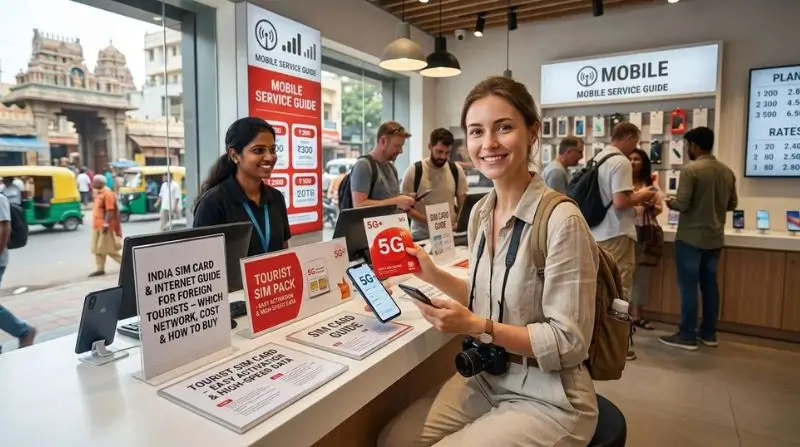
Staying connected is one of the first things most international travellers arrange after arriving in India. Mobile internet makes it easier to book hotels, use navigation, communicate with drivers, make digital payments and stay in touch with family back home. Fortunately, buying a SIM card in India has become much easier for foreign visitors, especially at international airports and authorised mobile stores.
India has one of the world's largest mobile networks, offering affordable data plans with excellent coverage across major tourist destinations. Whether you are visiting Rajasthan, the Golden Triangle, Kerala, Goa or the Himalayas, a local SIM card usually provides faster internet and significantly lower costs than international roaming.
For guests travelling with Royal Rajasthan Travels, having a working mobile connection from the beginning makes the journey much smoother. Mr. Vikas Khabrani and his team often assist international visitors with local travel information, hotel communication and navigation, making reliable internet access an important part of the overall travel experience.
Foreign tourists can purchase a prepaid SIM card shortly after landing at major international airports such as Delhi, Mumbai, Bengaluru, Hyderabad and Chennai. Airport counters are convenient because they are familiar with international documentation and can usually activate tourist SIM cards quickly.
Another option is to visit an authorised mobile network store in the city. These outlets often have a wider choice of prepaid plans and can explain the available data packages in English.
To complete the purchase, visitors generally need a valid passport, an Indian visa and a passport-sized photograph. Some providers may capture your photograph digitally during registration, depending on local procedures.
From your first arrival in India to the final leg of your journey, stay effortlessly connected with the right mobile plan, reliable internet and practical travel support - so you can focus on experiencing India.
Chat On WhatsApp Contact UsIndia has several mobile service providers, but three companies dominate the market for international travellers.
Jio has become the most popular network because of its fast 4G and expanding 5G coverage. It performs particularly well in cities such as Jaipur, Udaipur, Delhi, Agra and Mumbai. Travellers who expect to use large amounts of mobile data often choose Jio because its plans include generous daily data limits.
Airtel is another excellent choice and is widely regarded for its strong network reliability across tourist destinations. Many international visitors prefer Airtel because coverage remains consistent while travelling between cities.
Vi (Vodafone Idea) is available in many regions but generally has less consistent coverage than Jio and Airtel, especially in rural areas. For visitors travelling mainly through Rajasthan, Delhi and Agra, Jio or Airtel are usually the better options.
For most international tourists, either Jio or Airtel will provide reliable service throughout their journey.
Internet coverage is excellent across Rajasthan's major cities. Visitors travelling through Jaipur, Jodhpur, Udaipur, Pushkar, Mount Abu, Bikaner and Ajmer can expect stable mobile data suitable for navigation, messaging, video calls and social media.
Coverage remains good while travelling on highways between cities, although speeds may occasionally reduce in remote desert regions.
Destinations such as Jaisalmer, Ranthambore National Park and parts of the Thar Desert generally have mobile coverage, but internet speeds may vary depending on the exact location. During wildlife safaris or deep inside desert areas, temporary signal interruptions are normal.
For most visitors, these brief gaps have little impact because service returns quickly after reaching nearby towns or highways.
Most travellers use mobile internet for Google Maps, WhatsApp, email, online banking, ride-hailing apps and sharing photographs.
A standard prepaid tourist plan usually provides more than enough daily data for normal sightseeing. Visitors who regularly upload videos or work remotely may prefer plans with higher daily limits.
Since prepaid plans in India are inexpensive compared with many Western countries, many travellers simply choose larger data packages to avoid worrying about usage throughout their holiday.
Many modern smartphones support eSIM, making it possible to activate a mobile connection without inserting a physical SIM card. Some international travellers prefer setting up an eSIM before leaving home so they have internet access immediately after landing in India.
However, if your trip includes several weeks of travel across Rajasthan, Delhi, Agra and other parts of India, a local prepaid SIM card usually offers better value and higher data limits than most international eSIM plans.
Before travelling, check whether your phone supports eSIM technology and whether it is unlocked for international networks.
Wi-Fi is widely available across India's major tourist destinations. Most hotels, resorts, cafés and restaurants offer complimentary internet access for guests.
Luxury hotels generally provide reliable high-speed Wi-Fi suitable for video calls and remote work. Boutique hotels and heritage properties also offer internet service, although speeds may vary depending on the location.
While hotel Wi-Fi is convenient, having a local mobile connection remains useful for navigation, online bookings and communication while travelling between cities.
India has become one of the world's leading countries for digital payments. Many shops, cafés and restaurants accept mobile payments through QR codes, although international tourists often continue using credit cards or cash.
Mobile internet becomes especially useful when:
A stable internet connection allows travellers to manage most parts of their trip directly from their phone.
Keep navigation, communication, bookings and everyday travel within easy reach. With the right connectivity in place, explore India’s cities, countryside and Rajasthan’s remote landscapes with greater freedom and confidence.
Chat On WhatsApp Contact UsInstalling a few travel apps before arriving can make everyday travel much easier.
Google Maps remains the most reliable navigation tool for sightseeing and road travel. WhatsApp is widely used by hotels, tour operators and drivers for quick communication. Ride-hailing services are available in many large cities, while food delivery apps can also be useful during longer hotel stays.
Many museums, airlines and railway services also provide mobile applications that allow visitors to check schedules and receive travel updates.
Using public Wi-Fi is generally safe in hotels and reputable cafés, but travellers should avoid accessing online banking or entering sensitive personal information while connected to unsecured public networks.
Keeping your phone protected with a password, enabling two-factor authentication and using secure websites helps reduce online security risks during your holiday.
If you regularly work online while travelling, a VPN can provide an additional layer of privacy when connecting to public Wi-Fi networks.
Most visitors travelling through Rajasthan have very few connectivity problems. Cities such as Jaipur, Udaipur, Jodhpur, Pushkar, Ajmer and Bikaner enjoy excellent mobile coverage, while internet service remains available along most major highways connecting these destinations.
Even in areas such as Jaisalmer and parts of the Thar Desert, mobile service is usually available, although speeds may occasionally slow in remote locations. Visitors joining wildlife safaris in Ranthambore National Park may also notice temporary signal interruptions inside forest zones, which is completely normal.
For guests travelling with Royal Rajasthan Travels, staying connected is especially convenient. Private drivers remain in contact throughout the journey, hotel details can be shared instantly through WhatsApp and any itinerary updates can be communicated quickly. Mr. Vikas Khabrani and his team also assist international travellers with practical travel information, helping ensure a smooth and comfortable experience from arrival to departure.
Yes. International visitors can purchase prepaid SIM cards at major airports and authorised mobile network stores after completing the required verification process.
For most travellers, Jio and Airtel offer the best combination of coverage, internet speed and reliability.
Yes. Major cities including Jaipur, Udaipur, Jodhpur and Jaisalmer have good mobile coverage, with only occasional interruptions in remote desert or wildlife areas.
Most hotels, resorts and guesthouses provide complimentary Wi-Fi, although connection speeds vary between properties.
A local prepaid SIM card is usually much more affordable and provides significantly larger data allowances than international roaming plans.
Yes. Many international travellers use eSIM services, although local prepaid SIM cards often provide better value for longer holidays.
Yes. Google Maps works reliably across most tourist destinations as long as you have an active mobile data connection.
Mobile coverage is generally available in Jaisalmer and along most desert routes, although speeds may occasionally reduce in remote areas.
Yes. WhatsApp is one of the most commonly used communication apps in India and is widely used by hotels, tour operators and drivers.
Yes. Royal Rajasthan Travels provides customised private tours across Rajasthan and North India, with experienced drivers, carefully planned itineraries and on-tour assistance to help international travellers enjoy a smooth and well-connected travel experience.