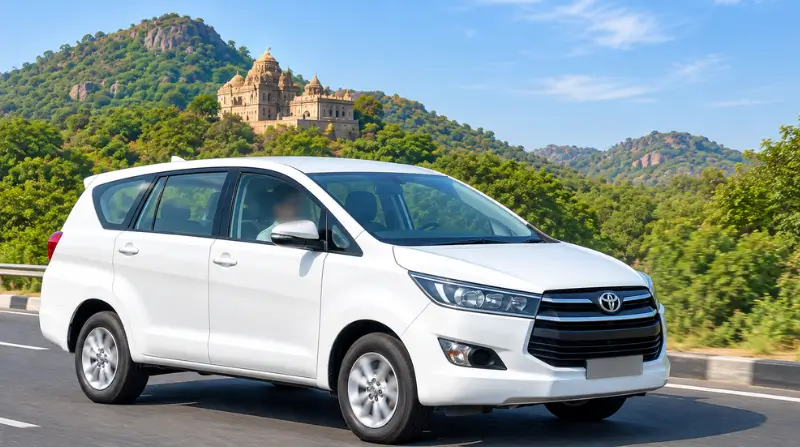
A private car with a professional driver is one of the most comfortable ways for international travellers to cover Delhi, Agra and Jaipur. The three cities are connected well by road, luggage stays in the same vehicle during intercity transfers, and guests can travel directly from one hotel to another without handling railway stations, separate taxis or repeated local transfers.
The price depends on much more than the number of days. Vehicle category, total kilometres, airport pickups, local sightseeing, the final drop-off point, tolls, parking, interstate charges and driver allowance can all influence the Golden Triangle private car and driver cost.
For a typical five-to-seven-day journey, two international travellers can reasonably allow approximately ₹30,000–₹45,000 for a private sedan with driver. An Innova-class vehicle may cost approximately ₹40,000–₹60,000, while an Innova Crysta can sit towards the higher side depending on route and service level.
A shorter Delhi–Agra–Jaipur journey that finishes in Jaipur can cost less than a complete Delhi–Agra–Jaipur–Delhi circuit because the passenger journey contains fewer kilometres. However, travellers should not assume that the operator has no return cost simply because they leave the vehicle in Jaipur. Commercial vehicle positioning can still form part of the quotation.
For families and groups, larger vehicles can be more economical per person. A Tempo Traveller costs substantially more than a sedan, but when the cost is divided among six, eight or ten passengers, it can provide excellent value.
The biggest mistake is comparing only the advertised daily taxi rate. A ₹4,000-per-day vehicle is not automatically cheaper than a ₹5,500-per-day quotation if the first price excludes fuel, tolls, parking and driver expenses.
International visitors should therefore compare the complete Delhi Agra Jaipur car and driver price, not one isolated rate.
Commercial tourist vehicles in India are often priced according to kilometres rather than a simple fixed daily rental. A minimum daily kilometre condition can also apply to outstation journeys.
For a sedan, a realistic working rate can be around ₹11–₹14 per kilometre, depending on the vehicle, operator and exact service. An Innova-class vehicle may work around ₹16–₹22 per kilometre, with premium variants towards the higher side.
A minimum of around 250 kilometres per day can apply on some multi-day outstation arrangements. This means a five-day booking could be calculated on a minimum of approximately 1,250 kilometres even if the passenger's actual movements are slightly lower.
The Golden Triangle itself creates substantial road mileage.
Delhi to Agra is approximately 230 kilometres depending on the starting point and route. Agra to Jaipur is roughly 240 kilometres. Jaipur to Delhi is approximately 280 kilometres.
The basic intercity circuit can therefore approach 750 kilometres before local sightseeing, airport pickups, hotel transfers or garage movements are included.
Delhi itself can create considerable daily mileage because its major attractions are spread across a large urban area. A sightseeing day can include Old Delhi, central New Delhi and monuments in the southern part of the city.
Agra sightseeing involves shorter local distances, but a hotel pickup, Taj Mahal visit, Agra Fort and additional sites still add kilometres.
Jaipur can also involve significant local driving. Amer lies away from the central city, while City Palace, Jantar Mantar and other attractions create further movements.
For this reason, a complete five-to-seven-day Delhi Agra Jaipur private taxi can easily involve 1,000 kilometres or considerably more once all vehicle movements are counted.
Garage-to-garage calculation is another important detail.
Some operators count kilometres from the time the commercial vehicle leaves its operating base until it returns. The guest may therefore see a total kilometre figure larger than the distance visible on a simple Delhi–Agra–Jaipur map.
This is not necessarily an extra or unfair charge. A commercial vehicle has operating costs even when it is returning without passengers. What matters is that the calculation is disclosed before booking.
For most international travellers, a fixed quotation covering the complete agreed route is easier to understand than paying an open-ended kilometre bill.
The quotation should clearly identify the destinations, number of days, vehicle category and inclusions. If the route remains unchanged, the traveller should know the transport cost before arriving in India.
From Delhi to Agra and Jaipur, enjoy a private car and professional driver with clear pricing and no unnecessary surprises.
Chat On WhatsApp Contact UsFor one or two travellers, a sedan generally provides the strongest value.
A comfortable air-conditioned sedan can handle the highways between Delhi, Agra and Jaipur without requiring the higher operating cost of an SUV. Two adults with normal luggage usually have enough space, particularly when the vehicle is used mainly for hotel transfers and sightseeing rather than carrying unusually large suitcases.
For a five-day Golden Triangle journey, a realistic sedan with driver cost can sit around ₹27,000–₹35,000, depending on total kilometres, route and inclusions.
A six-day arrangement may cost approximately ₹30,000–₹40,000.
For seven days, travellers can reasonably allow around ₹35,000–₹45,000 when the service includes substantial local sightseeing and a complete road circuit.
These figures should not be interpreted as fixed tariffs. A Delhi arrival at 2:00 a.m., several additional local excursions or a final Jaipur-to-Delhi airport transfer can change the amount.
A sample six-day vehicle budget could look like this:
| Transport Expense | Approximate Amount |
| Sedan and fuel | ₹27,000–₹32,000 |
| Driver allowance | ₹3,000–₹4,000 |
| Tolls and interstate costs | ₹2,000–₹4,000 |
| Parking and local charges | ₹1,000–₹2,000 |
| Approximate total | ₹33,000–₹42,000 |
An operator may bundle all of these costs into one price rather than showing them separately.
That is generally easier for international visitors because they do not need to carry cash for every toll or calculate the driver's daily allowance.
The traveller should still ask what happens if the route changes.
For example, adding Fatehpur Sikri between Agra and Jaipur can fit naturally into the road journey, but the sightseeing stop takes additional time. Adding a destination that requires a substantial detour is different and may increase the transport cost.
The same applies to extra days.
If a guest decides to stay one additional night in Jaipur and requires the car for sightseeing, the operator may charge another day plus any additional kilometres.
A clearly stated extra kilometre rate prevents confusion in these situations.
For couples, spending an additional ₹10,000–₹15,000 purely to move from a sedan to a larger vehicle is optional. If the sedan is modern, clean and properly air-conditioned, it can be perfectly comfortable for the Golden Triangle.
The money saved can instead be used for better hotels, professional guides or premium sightseeing.
An Innova-class vehicle becomes attractive when travellers want additional road comfort or carry more luggage.
The Toyota Innova is widely used for private touring in India because it provides more cabin space and luggage flexibility than a sedan. An Innova Crysta generally provides a more premium interior and can cost more.
For a five-to-seven-day Golden Triangle Innova with driver, international travellers can reasonably allow approximately ₹40,000–₹60,000, depending on the exact model, route and included charges.
A standard Innova-type vehicle may sit closer to the lower end. An Innova Crysta, longer mileage or more extensive local usage can move the cost towards the upper side.
The price difference becomes easier to judge across the whole journey.
Suppose a six-day sedan costs ₹36,000 and an Innova Crysta costs ₹50,000. The upgrade is ₹14,000, or approximately ₹2,333 per day.
For a couple, that additional amount buys more cabin and luggage space but does not change the sightseeing itself.
For four adults, however, the calculation is very different. A sedan is no longer a comfortable choice, especially with four large suitcases. An Innova becomes a practical requirement rather than a luxury upgrade.
International travellers should therefore tell the operator how many large suitcases they are carrying.
Passenger capacity and luggage capacity are not the same thing.
A vehicle advertised for six passengers may not comfortably carry six international travellers plus six large checked suitcases. In such cases, a Tempo Traveller may be more appropriate.
A larger vehicle can cost around ₹8,000–₹12,000+ per touring day on a Golden Triangle arrangement, depending on size and specification. For a group of eight travellers, even ₹10,000 per day becomes only ₹1,250 per person per day before tolls and other applicable charges.
Groups should also consider boarding comfort. Repeatedly entering and leaving an overloaded smaller vehicle during sightseeing can become frustrating even when the number of seats is technically sufficient.
For private touring, comfort should be calculated across several days rather than judged from a single short transfer.
A complete transport quotation should clearly state whether additional road expenses are included.
The driver allowance is commonly charged because the driver remains away from home during a multi-day journey. A realistic working figure can be approximately ₹400–₹700 per day when listed separately.
For six days, that represents roughly ₹2,400–₹4,200.
Many tour companies include this amount inside the complete quotation, which is simpler for travellers.
Tolls are another unavoidable road expense. Delhi, Agra and Jaipur are connected by major highways, and commercial vehicles can incur toll charges during the circuit.
Parking charges arise at monuments, airports, hotels and other designated areas. Individual fees may be modest, but several days of sightseeing create repeated parking expenses.
Interstate charges can also apply because the Golden Triangle crosses Delhi, Uttar Pradesh and Rajasthan.
A quotation saying "car and driver included" does not automatically confirm that every one of these expenses is covered.
Travellers should specifically ask whether the amount includes fuel, driver allowance, tolls, parking and interstate taxes.
Night charges can occasionally apply for very late or early vehicle usage. An international flight arriving after midnight is a common example. If the airport pickup occurs outside the normal tour period, the operator may charge separately.
Waiting time can also matter in unusual situations.
Normal monument visits and restaurant stops should not produce surprise waiting charges in a proper touring arrangement. However, using a car booked only for an airport transfer and then asking the driver to wait several hours is a different service.
The type of booking therefore matters.
A multi-day Golden Triangle car rental with driver should normally provide much greater daily flexibility than purchasing a sequence of individual taxi transfers.
That is one of the main advantages of keeping the same driver throughout the circuit.
Delhi airport is the starting point for many international Golden Triangle holidays.
Travellers should establish whether their vehicle service begins at the airport or at a Delhi hotel the following morning.
If the car service begins with airport pickup, the quotation should account for the arrival time and airport parking. Late-night arrivals may require different operating arrangements.
The vehicle can then remain with the guests for Delhi sightseeing before travelling to Agra.
This continuity is valuable because travellers do not need to negotiate a new taxi each morning. Their luggage remains with the same transport service, and the driver already knows the next hotel and road schedule.
In Agra, the vehicle handles hotel transfers and local sightseeing movements. A professional local guide can meet the guests separately for the Taj Mahal and other monuments.
The journey from Agra to Jaipur can include a stop at Fatehpur Sikri when the schedule allows. The vehicle then continues to Jaipur, where it remains available for agreed sightseeing.
The final drop is an important part of the price.
If the guests finish in Jaipur and no longer require transport, the passenger journey ends there. If they must return to Delhi for an international flight, the vehicle has another approximately five-to-six-hour road sector depending on traffic.
A Delhi Agra Jaipur Delhi car package should therefore cost more than a one-way Delhi–Agra–Jaipur passenger route when all other conditions are equal.
International travellers sometimes attempt to reduce cost by booking separate cars for each sector. This can work, but the saving may be relatively small once station transfers, local sightseeing vehicles and luggage handling are added.
Using one private vehicle also gives travellers one point of contact if timing changes.
For a short route such as the Golden Triangle, the convenience can justify a modest difference in price.
Forget changing taxis, managing transfers or worrying about the road. Travel seamlessly between Delhi, Agra and Jaipur with a dedicated vehicle.
Chat On WhatsApp Contact UsA professional quotation should contain enough information that the traveller can calculate the final transport expense without guessing.
For example, a six-day sedan quotation might state that the price covers Delhi airport pickup, Delhi sightseeing, Delhi to Agra, Agra sightseeing, Agra to Jaipur, Jaipur sightseeing and return to Delhi.
The vehicle category should be named clearly.
The price should then specify whether fuel, driver allowance, tolls, parking and interstate charges are included.
If additional kilometres are charged beyond the agreed route, the extra rate should be stated.
A quotation should also mention any restrictions on vehicle availability after normal touring hours. Private touring does not mean a single driver can safely work without reasonable rest.
A professional driver is responsible for road transport and practical support. Detailed historical guiding should be handled by local professional guides.
Royal Rajasthan Travels can arrange the vehicle according to passenger numbers, luggage and the actual road schedule rather than automatically placing every traveller in the same category. Mr. Vikas Khabrani's long experience with Rajasthan and North India touring can be useful when deciding whether a sedan is sufficient or an Innova upgrade will materially improve comfort.
For a couple, a well-maintained sedan generally offers the best Golden Triangle private taxi value. Families and travellers carrying substantial luggage should look towards an Innova-class vehicle, while larger groups should consider a Tempo Traveller.
The key is to compare complete prices.
A ₹32,000 sedan quote that later adds ₹8,000 of road expenses is effectively a ₹40,000 service. A ₹39,000 all-inclusive quotation may therefore be the better purchase even though its first number appears higher.
The traveller should know that before making a deposit rather than discovering it on the final day.
For a five-to-seven-day Delhi, Agra and Jaipur journey, a private sedan can reasonably cost approximately ₹30,000–₹45,000. An Innova-class vehicle can commonly cost around ₹40,000–₹60,000 depending on mileage and inclusions. The exact amount changes according to airport transfers, local sightseeing and the final drop-off point.
A commercial outstation sedan can commonly work around ₹11–₹14 per kilometre, depending on vehicle and operator. Minimum daily kilometre rules may apply, so the final quotation should be based on the complete route rather than a kilometre rate alone.
A multi-day Innova Crysta arrangement can commonly fall around ₹40,000–₹60,000 for five to seven days, although extensive local driving, airport transfers and a return to Delhi can increase the amount.
Some operators include tolls in a fixed package while others charge them separately. International travellers should ask for written confirmation because the route uses major highways and crosses multiple state or administrative boundaries.
It can be. A realistic driver allowance can be around ₹400–₹700 per day, although many complete Golden Triangle transport quotations already include it in the total price.
Yes. A good air-conditioned sedan is normally sufficient for two adults with reasonable luggage. An Innova becomes more attractive when travellers carry several large bags or want additional space during long road sectors.
Delhi to Agra commonly requires around three to four hours, Agra to Jaipur around four to five hours, and Jaipur to Delhi around five to six hours. Traffic, hotel location, stops and road conditions can change these times.
A driver provides transportation and practical assistance but should not automatically be treated as a professional monument guide. Delhi, Agra and Jaipur all benefit from licensed local guides for detailed historical sightseeing.
The passenger route is shorter than returning to Delhi, so it can be cheaper. However, the operator may still need to reposition the commercial vehicle, and that cost can form part of the quotation.
The quotation should state the vehicle category, complete route, number of days, kilometre conditions, fuel, driver allowance, tolls, parking, interstate charges, airport transfers, extra kilometre rate and final drop location. These details allow travellers to compare the actual transport price instead of relying on an incomplete daily rate.